
Original: $139.46
-70%$139.46
$41.84The Story
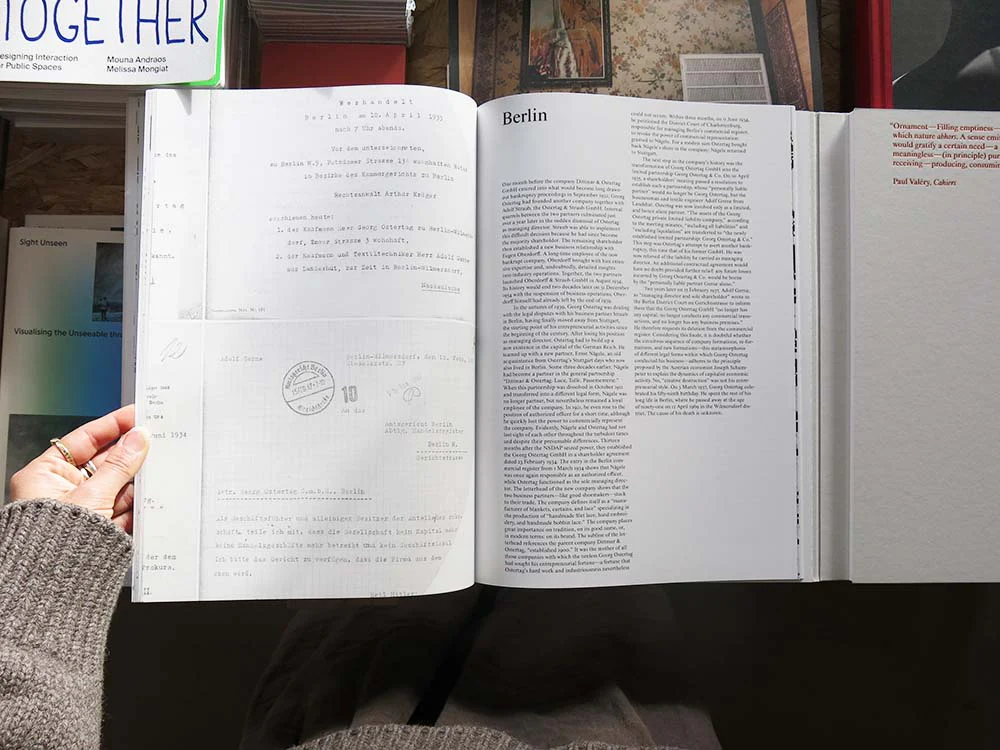
On September 18, 1900, the Dittmar & Ostertag company—specialising in ladies’ garment trimmings, wholesaler and agent for such articles—was entered in Stuttgart’s commercial register. Women made delicate bobbin lace at home, which the company sold worldwide in the course of its eventful history. Having combed through numerous archives, the artist Herbert Stattler uses thirty-eight drawings to recount the story of these craftswomen and the company, which ceased operations in 1954, and to acknowledge the significance of the lace the women created in the history of art. Lace Ware is a kaleidoscope of time fragments. The book delves into the harsh conditions of female home-based labour, while also revealing the intertwined histories of textiles, techno- logy, culture, and consumption in the first half of the twentieth century. Based on designs made by draftswomen, the lace patterns reflect the evolution from ornament and decoration to the aesthetic practice of autonomous form finding.
212 pages, 16 x 23 cm, softcover, Spector Books (Leipzig).

Details & Craftsmanship
Every detail has been carefully considered to bring you the perfect product.

Details & Craftsmanship
Every detail has been carefully considered to bring you the perfect product.

Details & Craftsmanship
Every detail has been carefully considered to bring you the perfect product.

Details & Craftsmanship
Every detail has been carefully considered to bring you the perfect product.

Details & Craftsmanship
Every detail has been carefully considered to bring you the perfect product.
Details & Craftsmanship
Every detail has been carefully considered to bring you the perfect product.

Details & Craftsmanship
Every detail has been carefully considered to bring you the perfect product.

Details & Craftsmanship
Every detail has been carefully considered to bring you the perfect product.

Details & Craftsmanship
Every detail has been carefully considered to bring you the perfect product.

Details & Craftsmanship
Every detail has been carefully considered to bring you the perfect product.

Details & Craftsmanship
Every detail has been carefully considered to bring you the perfect product.
Description
On September 18, 1900, the Dittmar & Ostertag company—specialising in ladies’ garment trimmings, wholesaler and agent for such articles—was entered in Stuttgart’s commercial register. Women made delicate bobbin lace at home, which the company sold worldwide in the course of its eventful history. Having combed through numerous archives, the artist Herbert Stattler uses thirty-eight drawings to recount the story of these craftswomen and the company, which ceased operations in 1954, and to acknowledge the significance of the lace the women created in the history of art. Lace Ware is a kaleidoscope of time fragments. The book delves into the harsh conditions of female home-based labour, while also revealing the intertwined histories of textiles, techno- logy, culture, and consumption in the first half of the twentieth century. Based on designs made by draftswomen, the lace patterns reflect the evolution from ornament and decoration to the aesthetic practice of autonomous form finding.
212 pages, 16 x 23 cm, softcover, Spector Books (Leipzig).